
Early attendees of the 2026 Annual Science Writers and Communicators of Canada Conference got the chance to learn how to host an interview panel in an up-close-and-personal opportunity
You’ve probably been there. Your organization is looking to host a number of scientists and industry stakeholders for a discussion panel. And they want you to run it.
Your blood runs cold. Beads of sweat start to form on your forehead. The task of managing multiple confident experts in their field. Having to balance egos and politics while making sure everyone gets their chance to speak. The bright stage lights bearing down. A microphone in front of you, echoing every cough and sniffle. All the while being watched by an audience of a few hundred science enthusiasts – and that’s just those in person.
Stressed out yet?
While it is critical that science communicators learn how to facilitate the sharing of science in every form, some are easier than others. In addition to a fear of public speaking, managing guests in front of a live audience can be a tricky balance.
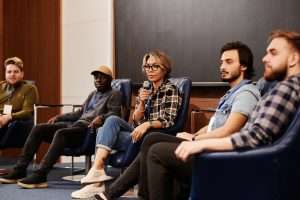
Photo by Henri Mathieu-Saint-Laurent via Pexels.
A Sign of the Changing Times
Prior to the first official day of the 2026 Annual Science Writers and Communicators of Canada (SWCC) Conference, attendees had the chance to learn how to handle this task in a small group setting. Not to get out of it, but to navigate it.
The theme of this year’s conference was ‘Discovery. Dialogue. Decision.’, which featured the critical role science communicators across the country, and around the world play – to find meaning in the chaos, while keeping up with rapidly evolving conversations and decisions. This year’s speakers, activities and workshops focused on how to keep the public informed as scientific progress accelerates in a highly polarized political space, alongside the decline of traditional science media.
Following events like the COVID-19 pandemic and the dismantling of world-renowned science organizations south of the border, it is now more important than ever for science communicators, writers and journalists to join that discourse and guide the discussion to where the public’s trust in science can return to what it once was.
Moderating for Impact
Hosted by Niki Wilson and Lesley Evans Ogden, two biologists turned multimedia science journalists, the ‘Moderating for Impact’ workshop is one of the many tools that science communicators can use to begin these critical efforts.
“Participants enter the workshop with a range of experience levels but often some trepidation about moderating,” says Evans Ogden. “This workshop is their chance to try things out in a low-stakes environment and receive real-time feedback from peers.”

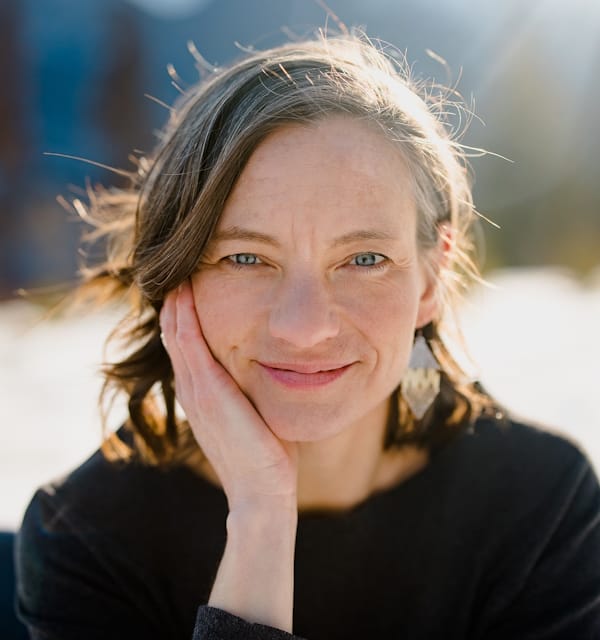
Lesley Evans Ogden (L) and Niki Wilson (R).
Here are some of the lessons which Lesley and Niki shared:
Know your format: This not only includes the structure of the interview, but how things will be positioned around you. This can also include wardrobe choices. For instance, if you know you’ll be sitting on a tall stool, will you be more comfortable wearing a skirt or pants? Will there be an aid, such as a clock or a time keeper, to help you guide talkative panelists?
Pre-show Warm-up: Before getting on stage, consider a vocal and body warm up. Nothing too fancy, just something to get the blood flowing.
Synthesize a take home message: As your panel is coming to a close, you want to make sure that there is a unifying message. Yes, everyone brings a unique perspective to your event, but you want your audience to walk away with something.
Have responses prepared: If something comes up which is getting off topic or you’re wading into controversial waters, it can get tricky to come up with something on the spot while also sounding rehearsed and thoughtful. In case of any hiccups, prepare some phrases ahead of time which you can use to get the conversation back on track.
Wrapping it all up
Following a morning of learning, participants had the chance to plan out their own panel event and navigate the characters that their peers threw at them. Posing as chatty personalities and quiet enthusiasts debating subjective topics, laughter soon wasn’t far behind. While it was a long day, participants felt well equipped to tackle their next hosting event.
“The ‘Moderating for Impact’ workshop was such a valuable experience, and a wonderful way to start the SWCC conference,” says workshop participant, Ed Pitt-Brooke. Pitt-Brooke is a Digital Communications Specialist at the University of British Columbia’s Faculty of Science.
They continue, “Lesley and Niki gave us clear, practical tips, and created a safe space for participants…I feel much more confident approaching the next event I need to host!”

Participants in the ‘Moderating for Impact’ workshop (Photo by Lesley Evans Ogden via LinkedIn).
For Wilson, the workshop is not just about educating science communicators, but allowing them to connect with their peers and develop exciting plans with these new tools at hand.
“The workshop participants [headed] into the conference with a new set of friends and connections. There are sometimes talks of future collaborations,” she says. “We are so thrilled to be a part of it.”
Other Events
If you missed out on the ‘Moderating for Impact’ workshop, there are other opportunities to learn from Lesley and Niki:
Lesley is hosting a workshop from May 31 to Jun. 4, 2027 called ‘Nature Writing in the Great Bear Rainforest’, an immersive small group workshop at Great Bear Lodge in British Columbia, Canada. The workshop group will spend time in the remote and beautiful Smith Inlet, using observations made in the natural environment to inspire new writing and learning some tips and tricks of the craft. More information can be found at her website: https://www.lesleyevansogden.com/naturewritinggbr.
Niki is hosting a workshop on Sept. 23-26, 2026 with the Bamfield Marine Sciences Centre (BMSC), called ‘Science Communication for an Ever-Changing World’. This workshop seeks to empower scientists and science students to effectively communicate their research and science to the world around them. More information can be found on the BMSC website. Registration is open on a rolling basis until Monday Sept 21, 2026: https://bamfieldmsc.com/education/prospective-students/courses/detail/scicomm-niki-wilson/
About the Author
Elizabeth Benner is a science writer and content producer. They currently serve as the Editor-in-Chief of the SWCC Blog.